Key takeaways
- All three platforms are enterprise-grade CMS options with headless delivery, AI features, and managed cloud deployment.
- Sitefinity (Progress) is recognised in the Gartner Magic Quadrant and Forrester Wave for DXP in 2025, with strength in multisite management and built-in CDP.
- Xperience by Kentico is an evergreen platform with no EOL dates, strong in hybrid headless delivery, and backed by the AIRA AI suite.
- Sitecore is the most enterprise-heavy option with the most complex implementation requirements and the highest total cost of ownership.
Australian enterprise organisations evaluating a CMS or DXP in 2026 frequently consider Sitefinity, Xperience by Kentico, and Sitecore together. All three are capable platforms. All three support headless delivery, AI content features, and managed cloud deployment. The differences are in scale, complexity, total cost, and which capabilities each platform executes most confidently.
Sitefinity: the balance of capability and manageability
Progress Sitefinity occupies the upper-middle of the enterprise CMS market. It is capable enough for complex multisite, multilingual, and personalisation requirements while remaining manageable for organisations without a large dedicated digital team.
The 15.4 release brings genuine AI capability: Agentic RAG search, Generative CMS for AI-assisted content creation, and RAG-powered hyper-personalisation. Sitefinity Insight, the built-in CDP, means customer data and personalisation are part of the same platform rather than an integration dependency. The Integration Hub, built on Workato, connects to over 1,000 third-party applications with low-code configuration.
- Multisite management: strong, with shared content and centralised governance
- AI: Agentic RAG, Generative CMS, hyper-personalisation built in
- Deployment: on-premises, PaaS (Azure), SaaS
- Headless: hybrid, ASP.NET Core and Next.js renderers
- Recognised in Forrester Wave DXP Q4 2025 and Gartner Magic Quadrant DXP 2025
Xperience by Kentico: evergreen and AI-ready
Xperience by Kentico (XbyK) is an evergreen platform: Kentico ships continuous updates with no major version end-of-life to plan around. This is a meaningful advantage for organisations tired of expensive version upgrade projects.
The AIRA Agentic Marketing Suite brings native AI to content creation, tagging, translation, and personalisation within the CMS. The hybrid headless model lets marketing teams use the page builder while development teams build headless frontends from the same content, without separate systems.
- Evergreen delivery: no EOL dates, continuous updates
- AIRA AI suite: content generation, tagging, translation, personalisation
- Hybrid headless: traditional and headless from the same instance
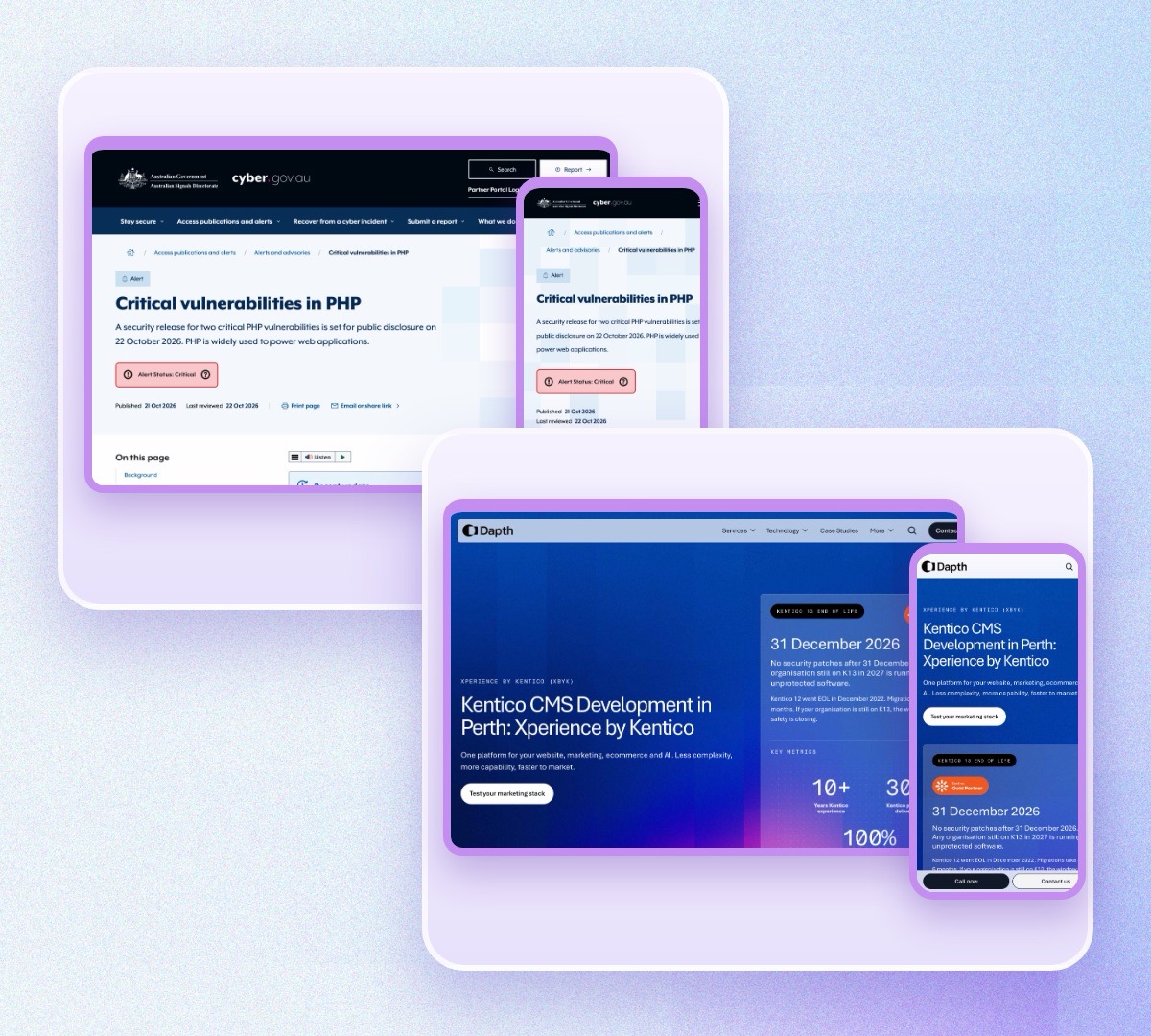
- Gold Partner and Accelerator Expert: Dapth is one of the few qualified partners in Australia
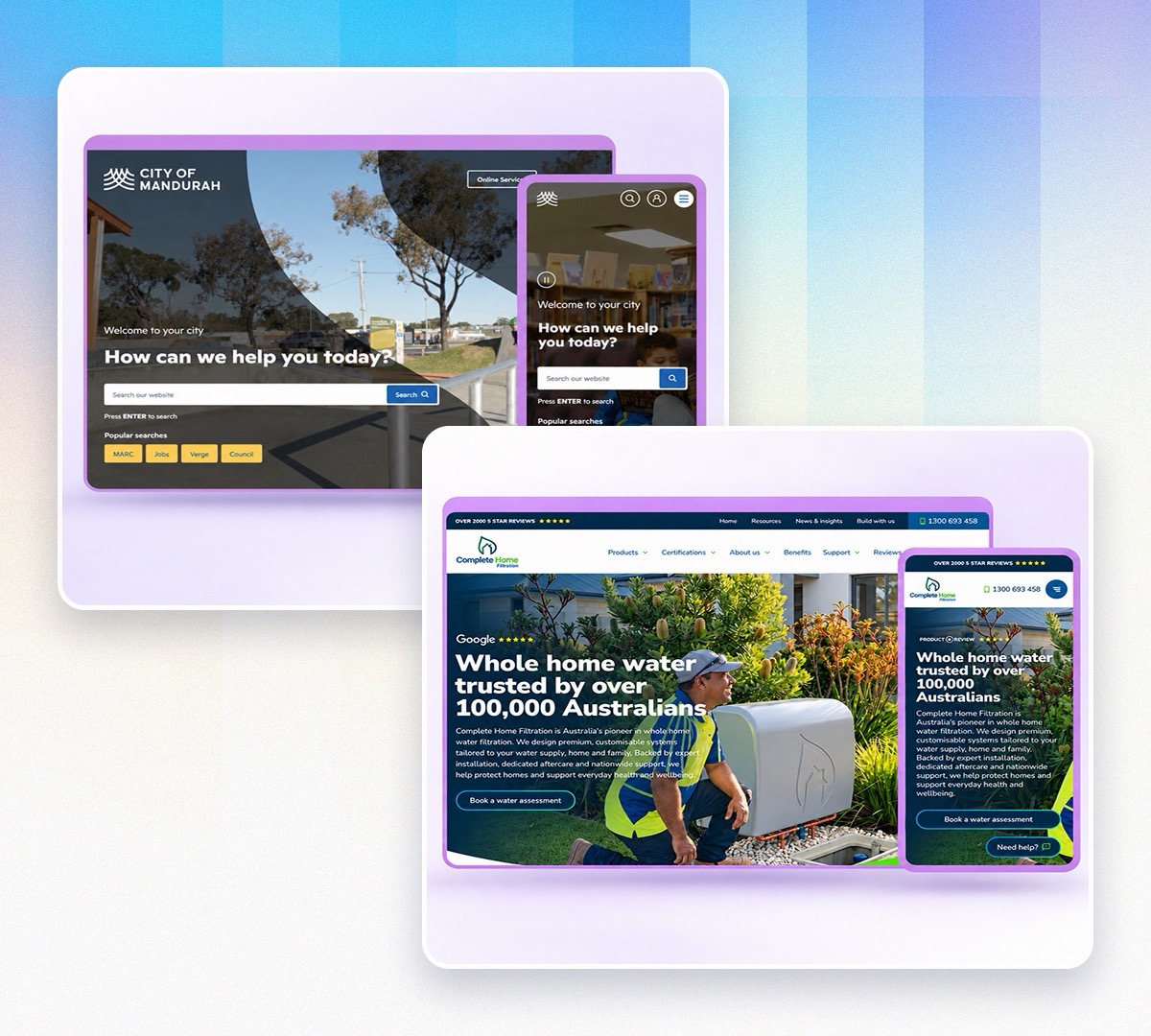
In practice: in September 2026, Kentico named two Dapth-built Xperience by Kentico sites, the City of Mandurah council website and Complete Home Filtration, as Site of the Month. See what the two sites have in common.
Sitecore: enterprise-first at enterprise scale
Sitecore is the most capable platform of the three for complex personalisation at scale, multi-market orchestration, and enterprise marketing automation. It is also the most complex to implement and the most expensive to own and operate.
Sitecore has undergone significant architecture changes in recent years, moving to a composable DXP model with separate products for content, experience, and analytics. This composable approach offers flexibility but also requires more integration work and more vendor dependency to achieve a complete solution.
How to choose
The choice depends on organisational scale, technical resources, and capability priorities.
- Choose Sitefinity if: you need enterprise multisite, multilingual, built-in CDP, and proven AI capability in a platform that does not require a large dedicated technical team to operate.
- Choose Xperience by Kentico if: you want an evergreen platform without EOL cycles, strong hybrid headless delivery, and Australian partner support from a certified Accelerator Expert.
- Choose Sitecore if: your organisation has large-scale personalisation requirements, a dedicated digital team, and the budget for the most enterprise-heavy investment.
About Dapth
Dapth helps organisations “unlock business advantage” by connecting customer, employee and operational systems into scalable digital ecosystems. Built on understanding, knowledge and collaboration delivering ROI through efficiency and/or revenue.
-Large.jpeg)




-Large.jpeg)


_web.webp)
-Large.jpeg)

-Large.jpeg)
-Large.jpeg)
-Large.jpeg)

-Large.jpeg)