Odoo supports multiple POS instances across different physical locations, all connected to the same inventory and accounting.
Product variants (size, colour, style) are configured once and published automatically to both in-store POS and the online eCommerce store.
Loyalty programs, gift cards, and eWallets work across every channel. A customer earns points in-store and redeems them online.
Stock adjustments from any location update the central inventory in real time, so every store and the website always show accurate availability.
Managing a retail business with multiple physical locations is complex enough on its own. Add an online store to the mix and you introduce a new set of problems: which system holds the real inventory number? What happens when a customer earns loyalty points in one store and wants to use them in another? How do you reconcile daily sales across three POS systems and a website into one set of accounts? Odoo answers all of those questions by putting everything in one platform.
Modules used: Point of Sale + eCommerce + Inventory + Accounting + Email Marketing + Loyalty Programs
One product catalogue across every channel
In Odoo, products are configured once. You set the product name, description, variants (size, colour, style), pricing, and images in a single place. That product is then available in every POS terminal across your locations, and automatically published to your eCommerce store with the same information.
For clothing retailers, the variant grid lets you display all combinations of a product's attributes together, which is exactly how clothing is bought and sold. Configure a t-shirt with five sizes and four colours, and Odoo handles the 20 SKUs that creates across every channel.
Real-time inventory across every location
When a customer buys a product at your Fremantle store, the stock level updates immediately. The system at your Perth CBD store sees the same updated count. Your online store shows the same number. If you have a warehouse supplying all three locations, Odoo tracks inbound stock and distributes it according to replenishment rules you configure.
Multi-warehouse support: stock tracked separately per location
RFID barcode integration: speed up stock counts across all locations
Real-time visibility: see stock across every location from one screen
THE RESULT: A customer calls your CBD store asking if you have a size 12 in a particular shoe. The staff member checks Odoo and can immediately see that your Joondalup store has two in stock. They can reserve it, raise a transfer, and call the customer back in minutes, all from the same screen.
Loyalty programs that work across every channel
Odoo's loyalty engine supports coupons, loyalty cards, promotions, eWallets, and gift cards natively. And because it is connected to both POS and eCommerce, these work across every channel.
A customer earns loyalty points at your physical store on a Saturday morning. They browse your website on Sunday, apply those points at checkout, and complete the purchase online. The balance updates in real time across both channels without any manual reconciliation.
• Loyalty cards: points earned in-store and online, redeemable anywhere
• Gift cards: sold in-store, redeemable online or at any other location
• eWallet: refunds go to eWallet rather than back to a card, keeping revenue in your ecosystem
• Promotions: configure percentage discounts, buy X get Y, or minimum spend rules across all channels
• Coupons: generate and distribute codes via Email Marketing, redeemable in POS and eCommerce
Click and collect: online purchase, in-store pickup
Odoo supports click and collect natively. A customer places an order on your website and selects a pickup location. The relevant store receives the pick task in their Odoo POS. When the order is ready, the customer is notified. When they arrive and collect, the sale is recorded and the inventory updates. No separate fulfilment tool required.
Accounting across every location from one place
Every transaction from every POS terminal and every online order flows into the same Odoo Accounting module. End-of-day reconciliation is automatic. GST is calculated correctly on every transaction. Financial reports cover all locations by default, with filtering by store available when you need location-level analysis.
For Australian retailers with multiple ABNs or company structures, Odoo supports multi-company configurations with shared products and separate accounting entities.
About Dapth
Dapth helps organisations “unlock business advantage” by connecting customer, employee and operational systems into scalable digital ecosystems. Built on understanding, knowledge and collaboration delivering ROI through efficiency and/or revenue.
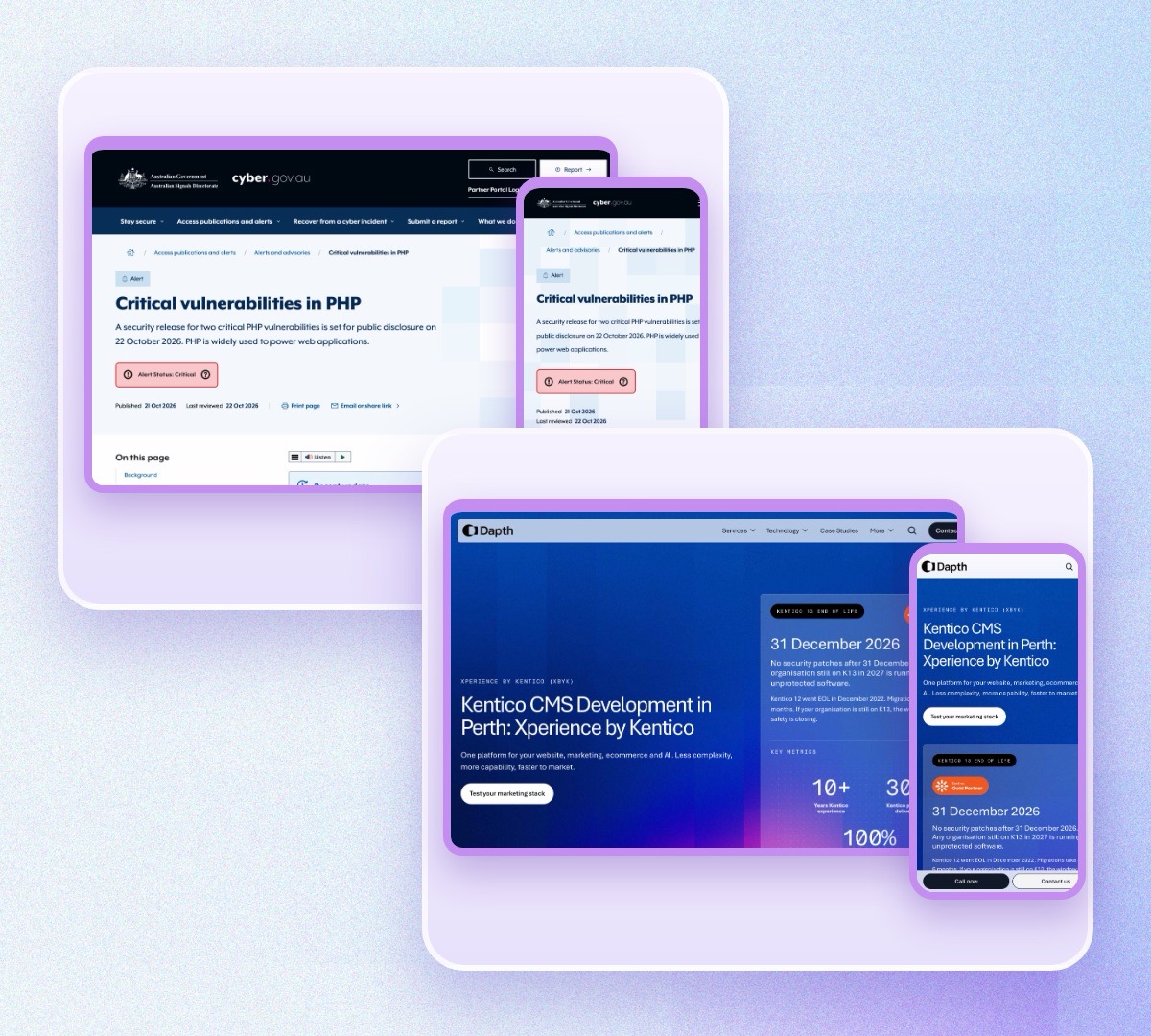
Two critical PHP flaws put Australian websites on alert this week, and some older versions have no official fix. Here is what to check, which versions are patched, and why support dates decide how fast you can respond.
Most SharePoint migrations copy the clutter across and call it done. Here is how Dapth's SharePoint team restructures first, moves content in stages while staff keep working, and decides what never gets migrated at all.
What happens when your EFTPOS, POS and ERP actually talk to each other? Explore how Linkly integration with Odoo can simplify payments and reconciliation.
What is an ERP, what does it actually cost, and is it right for your business? This plain-English guide breaks down how ERP systems connect your operations, where implementations go wrong, and what Australian businesses should consider before making the move.
Most CMS comparisons stop at a feature checklist. But two platforms with near-identical feature lists can differ by hundreds of thousands of dollars a year to own, and by whether your marketing team can launch a campaign without raising a developer ticket. Here's the methodology behind Dapth's CMS Autonomy Matrix, and the evidence behind where each platform sits.
Digital ConsultancyContent Management SystemsXperience by KenticoCustomer Experience
95% of enterprise AI pilots deliver no measurable ROI. Discover the evidence, insights and practical strategies helping WA organisations build AI initiatives that deliver real business value.
Not a developer. Just a marketer managing a website, running campaigns, and publishing content. Here is what that actually looks like in Kentico Xperience.
Xperience by KenticoContent Management SystemsCustomer Experience
Three enterprise CMS platforms assessed honestly: AI capabilities, headless delivery, deployment flexibility, and which type of organisation each suits best.
SitefinityXperience by KenticoContent Management SystemsCustomer Experience
Umbraco.AI takes a different approach to CMS AI: define rules and governance first, then activate AI features for editors. Here is what that means in practice.
-Large.webp)




-Large.jpeg)

_web.webp)
-Large.jpeg)

-Large.jpeg)
-Large.jpeg)
-Large.jpeg)

-Large.jpeg)

-Large.jpeg)