

Introduction
Agile Scrum gets mentioned in almost every conversation about modern software development, and almost as often, misunderstood. Teams call daily meetings "stand-ups" and two-week cycles "sprints" without necessarily following the roles, events, and artefacts that actually make Scrum work.
That gap matters. A team running "Scrum-ish" without the actual structure underneath it tends to get the downsides, meetings, ceremony, overhead, without the upside: faster feedback loops, clearer priorities, and a genuine reduction in wasted work.
This guide covers what Agile Scrum actually is, the pillars and values it's built on, how it compares to Kanban, where it came from, and how to tell whether a team running Scrum is actually getting the benefits it promises.
Here's everything you need to know in under a minute
- Agile is a philosophy; Scrum is a specific framework for putting that philosophy into practice through fixed-length sprints
- Scrum is built on three pillars, transparency, inspection, and adaptation, and five values: commitment, courage, focus, openness, and respect
- A Scrum team has three roles: Product Owner, Scrum Master, and the Development Team, each with distinct accountabilities
- Scrum suits product and feature development where predictability and structure matter; Kanban suits continuous flow work like support or operations
- Scrum was developed in the early 1990s by Jeff Sutherland and Ken Schwaber, building on ideas first described in a 1986 Harvard Business Review article
- Sprint velocity and burndown charts are the standard ways to measure whether a Scrum team's process is actually improving over time
- Cross-functional Scrum teams typically need more than developers, design, business analysis, and QA skills all belong inside the team, not outside it
Table of contents
- What is Agile Scrum methodology?
- The Scrum methodology
- What are the three pillars and five values of Scrum?
- Where did Scrum come from?
- The Scrum framework
- How does Scrum compare to Kanban?
- Scrum process in action
- How do you measure whether Scrum is actually working?
- Applying Scrum in Agile environments
- How does Dapth apply Scrum across different types of projects?
- The takeaway
- Frequently asked questions
What is Agile Scrum Methodology?
Defining Agile Scrum Methodology
Agile Scrum is a methodology combining the best of both worlds - the agile philosophy and Scrum frameworks. It allows teams to develop projects in small increments using sprints, which are sizeable chunks of work. This approach offers several benefits - including faster product development and more efficient project management by breaking it down into smaller stages.
The greatest benefit of the Scrum method in Agile lies in its flexibility. Stakeholders can provide feedback after each sprint, meaning it allows for frequent adjustments, unlike traditional project management systems that don't provide stakeholders with regular feedback. This way, stakeholders are involved in each step.
Agile Scrum methodology is defined by a dynamic, iterative framework focused on collaboration, adaptability, and incremental progress. This methodology is essential in the ever-evolving landscape of project development, and Agile Scrum has had a transformative force on project management.
The Scrum Methodology
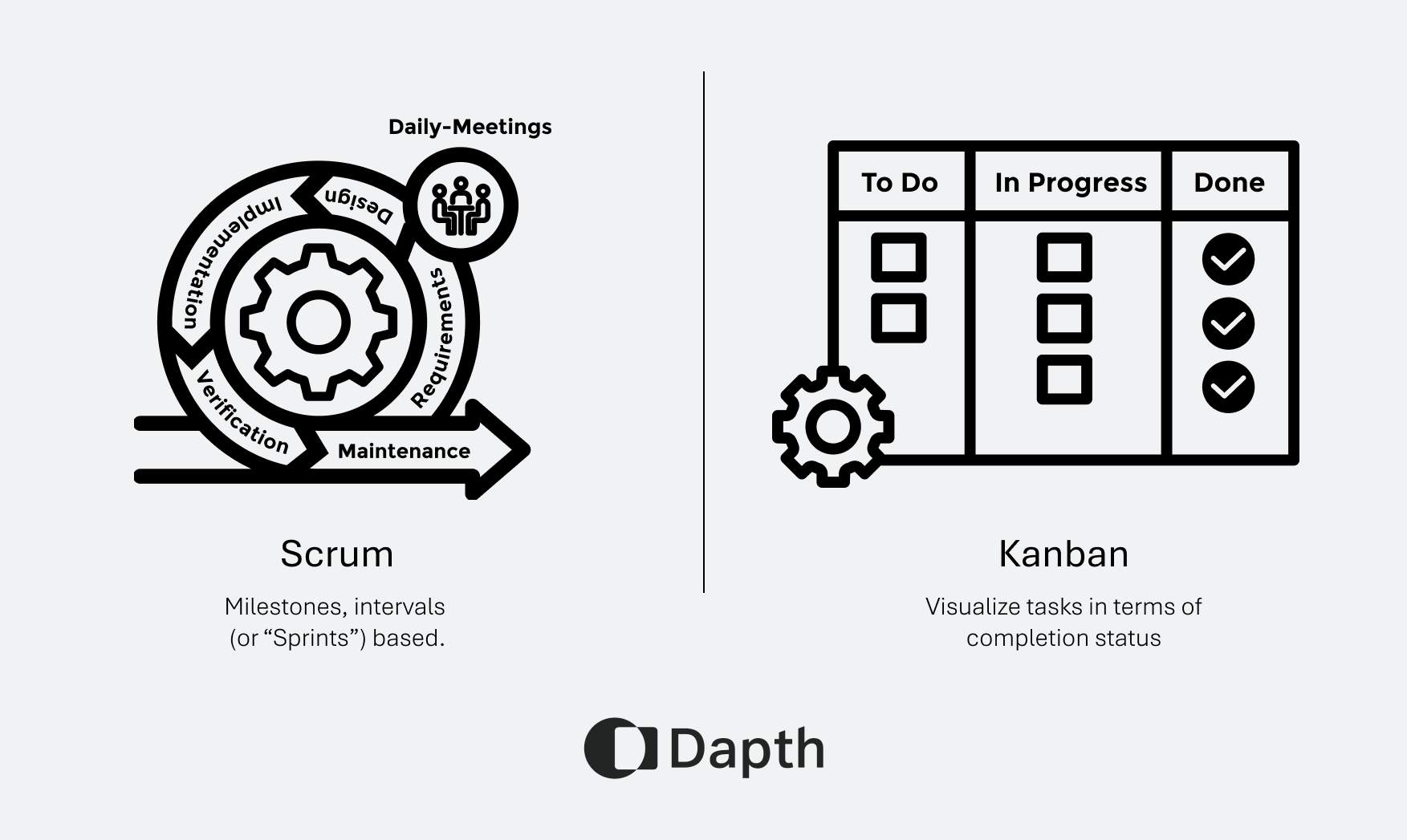
Scrum encourages teams to learn through experiences, self-organise while working through problems, and reflect on wins and losses for continuous improvement. Scrum is a framework for getting work done, whilst agile is more of a philosophy.
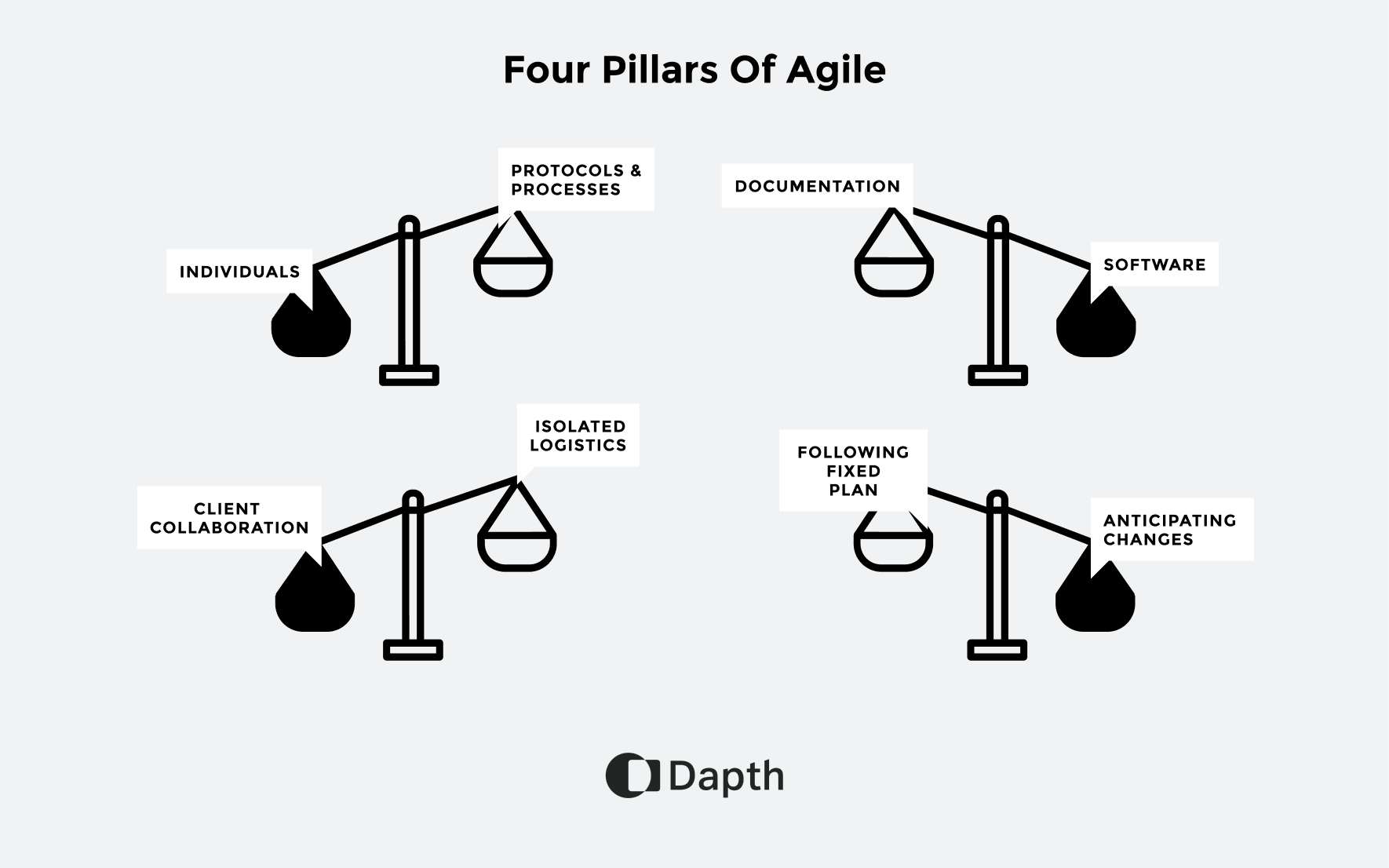
The philosophy at the heart of Agile methodology is based on making incremental improvements continuously. To adopt this approach, you can use a framework such as Scrum which can help you begin thinking in an Agile manner. The Agile manifesto emphasises four key values serving as guiding principles:
- Individuals and interactions over processes and tools
- Working software over comprehensive documentation
- Customer collaboration over contract negotiation
- Responding to change over following a plan.
Scrum and traditional project management methodologies differ fundamentally in their approach. While traditional methods are based on assumptions, Scrum is based on both lean thinking and empiricism. Empiricism suggests that knowledge comes from experience, and decisions should be made based on what is observed. In contrast, lean thinking focuses on reducing waste by emphasising essentials. Scrum is structured around helping teams adapt to ever-changing conditions and user experience naturally. It includes re-prioritisation as an integral part of the process and short release cycles to facilitate constant learning and improvement. Whilst the execution can be tailored to the needs of any organisation, the following should always remain front and centre:
- Transparency
- Clear communication
- Dedication to continuous improvement

Exploring Scrum methodologies
There are various core principles and practices to the Scrum methodology, which were first described in the ‘Agile Manifesto’ by a group of developers exploring a new approach to software development. Core values within the manifesto include:
- Individuals and interactions over processes and tools
- Working software over comprehensive documentation
- Customer collaboration over contract negotiation
- Responding to change by following a plan
In Agile methodology, principles such as prioritising customer satisfaction, embracing change, and promoting collaboration between business and developers are foundational. This approach emphasises early and continuous delivery, aiming for frequent iterations to ensure that functional products are delivered promptly. It also values technical excellence, simplicity, and self-organised teams, fostering an environment where motivated individuals can thrive. Additionally, Agile encourages face-to-face conversations and emphasises the importance of regulation, reflection, and adjustment throughout the development process.
Scrum project management is a way for teams to work together on complex tasks or projects and includes meetings, roles, and tools to help teams collaborate and manage their workload. Much like a sports team practising for a big match, Scrum practices allow teams to:
- Self-manage
- Learn from experience
- Adapt to change
Scrum is an effective framework for managing complex projects and promoting collaboration, transparency, and adaptation. The term initially was borrowed from Rugby - the term Scrum refers to a way of restarting play after an infringement. Similarly, in Scrum, the team restarts the project every sprint with the goal of delivering unmatched value to the customer.

What are the three pillars and five values of Scrum?
Scrum's structure, roles, events, artefacts, rests on a smaller set of ideas that explain why the framework works the way it does.
Three pillars support Scrum's empirical approach to work:
- Transparency — the work and the process must be visible to everyone responsible for the outcome, not hidden inside one person's head or one team's private notes.
- Inspection — progress is checked frequently enough to catch problems early, without slowing the work down to check it constantly.
- Adaptation — when inspection reveals something isn't working, the team adjusts, rather than sticking to a plan that's clearly gone stale.
Five values guide how a Scrum team behaves day to day: commitment to the team's goals, courage to raise hard problems, focus on the current sprint rather than everything at once, openness about progress and blockers, and respect for every team member's contribution.
None of these are abstract ideals. A team missing openness hides slipping deadlines until it's too late to fix them. A team missing focus never finishes what it starts. The pillars and values aren't a poster on the wall, they're the reason the roles, events, and artefacts covered elsewhere in this guide actually produce better outcomes than working without them.
Where did Scrum come from?
Scrum's structure didn't appear fully formed. The underlying idea traces back to a 1986 Harvard Business Review article that compared high-performing, cross-functional teams to a rugby scrum, a tight, coordinated unit moving the ball forward together rather than passing work between separate specialists.
Jeff Sutherland and Ken Schwaber formalised that idea into the Scrum framework in the early 1990s, developing it specifically to manage the complexity of software projects that traditional, sequential project management struggled to handle. Their work became the Scrum Guide, still the definitive reference for the framework today.
Scrum has since moved well beyond its software origins. It's now used across marketing, operations, and product teams of every kind, and remains the most widely adopted Agile framework in use, chosen by roughly two-thirds of teams practising Agile in some form.
The Scrum Framework
The Scrum framework is a widely used Agile methodology employed in software development to manage and complete complex projects effectively. It is based on a set of guidelines and principles that help teams work collaboratively and deliver high-quality products efficiently. To understand the Scrum framework - it's essential to understand its key components – including roles, events, and artefacts.
During Scrum project management, roles within the Scrum framework are divided into three key positions:
- Scrum Master
- Product Owner
- Development Team.
The Scrum Master is responsible for ensuring that the Scrum framework is being implemented correctly and the process is facilitated smoothly. The Product Owner is responsible for defining and prioritising the product backlog, which includes the features, enhancements, and bug fixes that are being prioritised for the development team. The Development Team is a collaborative and cross-functional team responsible for delivering the product.
Scrum methodology employs several events to help teams collaborate and ensure the project is on track. The key events in Scrum include Sprint, Daily Scrum, Sprint Review and Sprint Retrospective.
Sprint refers to a time-boxed development iteration when the Development Team works on the items from the product backlog. Daily Scrum is a daily stand-up meeting aimed at the Development Team to discuss the progress made so far, any roadblocks, and the plan for the day. The Sprint Review is an evaluation of the increment that has been achieved during the Sprint, and the Product Owner adapts the product backlog accordingly. The Sprint Retrospective is a reflective session to discuss the past Sprint and plan for improvements. The Scrum framework employs several artefacts to support the development process, including:
- Product Backlog
- Sprint Backlog
- Increment
- Burndown Chart
The Product Backlog is a list of prioritised items that are being developed by the Development Team. The Sprint Backlog is a subset of the Product Backlog that is selected for a specific Sprint. The Increment is the sum of all the completed Product Backlog items within a Sprint. The Burndown Chart visually represents the work completed and remaining over time.
The Scrum framework is an iterative and incremental Agile methodology focused on delivering customer value. It emphasises teamwork, communication, and collaboration, and the key components include roles, events, and artefacts. By following the Scrum framework, teams can deliver high-quality products efficiently and effectively.
How does Scrum compare to Kanban?
Scrum isn't the only Agile framework, and it isn't always the right one. Kanban, its most common alternative, takes a fundamentally different approach to structuring work.
| Scrum | Kanban | |
|---|---|---|
| Structure | Fixed-length sprints | Continuous flow, no fixed iterations |
| Roles | Prescribed: Product Owner, Scrum Master, Development Team | No prescribed roles |
| Work intake | Planned at the start of each sprint | Pulled in whenever capacity frees up |
| Best suited to | Product and feature development needing structure and predictability | Continuous, unpredictable work like support or operations |
Scrum's fixed sprints and defined roles give teams predictability, useful when a business needs to plan releases and forecast delivery dates. Kanban's continuous flow suits work that arrives unpredictably and needs to be picked up quickly, support tickets, ad hoc requests, or operational tasks that don't fit neatly into a two-week box.
Some teams blend the two, keeping Scrum's backlog and planning discipline while adopting Kanban's flexibility in how work moves through execution, often called Scrumban. The right choice depends on whether the work itself is predictable enough to plan two weeks ahead, not on which framework is more fashionable.
Scrum process in action
The Scrum process involves several phases, each with its own unique purpose. To walk through the Scrum process, let's start with sprint planning and go through to the sprint review and retrospective.
The first phase is sprint planning, where the Scrum team collaboratively plans the work for the upcoming Sprint. During this phase, the team defines sprint goals and selects the backlog items that will be tackled during the iteration. It is a crucial step for ensuring that everyone is on the same page and working towards a common goal.
Next, are the daily stand-ups, key to the Scrum process. During these meetings, team members provide updates on their progress, share any impediments and coordinate efforts to ensure that everyone is aligned. These meetings are quick and focused, usually only lasting around 15 minutes, and promote transparency and open communication.
Scrum ceremonies are another important aspect of the Scrum process. These include sprint planning, daily stand-ups, sprint reviews, and 'metro retros' (a fancy way of saying retrospective). These ceremonies are collaborative and transparent and help promote team efficiency by encouraging open communication, shared understanding, and continuous improvement. During the sprint review, the Scrum team presents the completed work to stakeholders, gathering feedback and ensuring that the product or service aligns with stakeholder expectations. This iterative process is client-focused and promotes collaboration. Finally, in the sprint retrospective, the team reflects on the overall sprint, identifying areas of improvement and devising strategies to enhance future performance. This is an important step in the Scrum process as it helps the team to continuously improve its processes and work towards achieving its goals. The collaborative and transparent nature of Scrum ceremonies in fostering team efficiency.
A self-organised Scrum team comprises 3 to 9 individuals with business, design, analytical and development skills to execute work, solve problems and produce products. Members of the Scrum team are responsible for meeting each sprint’s goals and self-administering tasks.
How do you measure whether Scrum is actually working?
Adopting Scrum's ceremonies doesn't automatically mean a team is getting Scrum's benefits. Measuring whether the process is actually working matters just as much as running it.
Sprint velocity, how much work a team reliably completes per sprint, is the most common measure, useful for forecasting future sprints once it stabilises over several cycles. Burndown charts track remaining work against time within a single sprint, making it visible early if a team is falling behind rather than discovering it on the last day.
Beyond raw output, cycle time (how long an item takes from start to finish) and defect rates say more about whether quality is holding up under the pace of delivery. A team hitting its velocity target while defect rates climb isn't actually improving, it's borrowing against future sprints.
The sprint retrospective is where these numbers should actually change something. A retrospective that surfaces the same problem three sprints running without a fix isn't doing its job, regardless of how well-attended the meeting is.
Applying Scrum in Agile Environments
Scrum is one of the most widely used Agile frameworks seamlessly integrated into the broader context of Agile project management methodologies. This framework is built upon the core principles of Agile, including iterative development, collaboration, and responsiveness to change.
One of the significant advantages of Scrum is its adaptability to different project types and team structures. Scrum's versatility in handling projects with ever-evolving requirements is due to its incremental approach that focuses on iterations. This leads to a dynamic, responsive development process where the project team can easily manage changes and adapt to new requirements.
Scrum is an ideal methodology for Agile environments, given its adaptability to various project types and the key methodologies and frameworks that define its implementation. This framework is particularly useful for complex projects, as it offers a clear structure for planning and executing work, while also providing flexibility to accommodate changes. Overall, Scrum is a powerful Agile methodology that can help project teams achieve their goals more efficiently and effectively, while also ensuring that they remain adaptable to changing circumstances.
How does Dapth apply Scrum across different types of projects?
Scrum isn't limited to greenfield software builds. The same framework applies across the different types of projects Dapth delivers for clients.
For customer-facing products, that includes mobile app development, where short sprints and frequent stakeholder reviews matter even more given how quickly user expectations shift on mobile platforms. For internal enterprise projects, the same discipline applies to sharepoint consulting work, where sprints keep a rollout visible to stakeholders instead of disappearing into a long, opaque build phase.
Design isn't bolted onto Scrum after the fact either. A genuinely cross-functional Development Team includes the people responsible for UX & UI Design Services from the first sprint, not as a separate phase that happens before development starts. That's what keeps a Scrum team from shipping technically complete increments that still miss what users actually need.
Whatever the project type, the same three pillars and five values covered earlier in this guide apply. Scrum's structure doesn't change with the platform, only the specifics of what gets built inside it.
The takeaway
The Agile Scrum methodology is a truly dynamic and collaborative framework that empowers teams to navigate the complex world of software development in a highly efficient and agile manner. With its core concepts of iterative development, adaptive planning, and continuous improvement, Scrum offers a flexible and structured approach that is well-suited for achieving project success.
Scrum is a powerful method for achieving project success and is known to be a highly effective methodology for robust Agile project management. The Scrum methodology is known for its self-organising teams, emphasis on communication, flexibility, and client collaboration. This makes it a robust framework that can easily adapt to changing requirements. Scrum is highly effective in enhancing efficiency, promoting team collaboration, and delivering high-quality results that meet stakeholder expectations.
By embracing the Scrum methodology and Scrum project management, you can confidently navigate the complex world of software development and ensure project success. Scrum is a proven and effective methodology that is widely used and trusted in the industry, making it a great methodology to use for robust Agile project management.
As the Agile Scrum methodology highlights the importance of adaptability, collaboration, and rapid iteration in the software development process, it's crucial to partner with a team that not only understands these principles but lives by them. This is where a specialised software development company comes into play, offering expertise and tailored solutions to meet complex project requirements. Dapth, renowned as a leading custom software development company in Perth, embodies these Agile principles in every project we undertake. Whether you're looking to enhance your current systems or embark on a new project, our team of expert Perth software developers are equipped to deliver high-quality, agile solutions that drive success. Explore how Dapth can transform your project ideas into reality by visiting our custom software development service page and contacting our team.
Frequently Asked Questions
- Initiate: Define the project vision and goals.
- Plan and estimate: Determine the tasks and estimate time for completion.
- Implement: Execute the plan by developing and testing the product incrementally.
- Review and adapt: Review progress, gather feedback, and make necessary adjustments.
- Release: Deliver the completed product increment to stakeholders.
- Empirical process control: Decision-making based on observation and experimentation.
- Self-Organisation: Teams organise themselves to accomplish tasks.
- Collaboration: Close collaboration among team members and stakeholders.
- Value-Based Prioritisation: Prioritising tasks based on their value to the customer.
- Time-Boxing: Setting specific time limits for tasks and activities.
- Iterative Development: Incremental development with frequent reviews and adjustments.
The Scrum framework is an Agile methodology used in project management, particularly in software development. It emphasises iterative development, collaboration, and flexibility. Scrum divides projects into small, manageable units called sprints, with a focus on delivering high-value features quickly and adapting to changing requirements.
Scrum is a specific Agile framework, while Agile is a broader philosophy or approach to project management. Agile emphasises flexibility, collaboration, and customer satisfaction, while Scrum provides a structured framework with defined roles, events, and artefacts to implement Agile principles in project development.
Scrum is not an acronym, it is derived from the sport of rugby, where it refers to a method of restarting play after an infringement. In the context of project management, Scrum represents a framework for managing complex projects efficiently and collaboratively.
Most Scrum sprints run for two weeks, though anything from one to four weeks is common. Shorter sprints suit complex, fast-changing work where frequent feedback matters most, while longer sprints can suit teams delivering larger increments with more predictable scope. Whatever length a team chooses, keeping it consistent from sprint to sprint is what makes velocity and forecasting meaningful over time.
No. Scrum's rules, roles, and events are documented publicly in the Scrum Guide and can be learned without a paid course. That said, formal certifications like Certified Scrum Master or Professional Scrum Master give a team a shared vocabulary and a structured way to learn the framework properly, which can shorten the learning curve for teams new to Scrum, particularly the Scrum Master role.
Running a project and want a team that actually practises Scrum properly, not just the ceremony? Dapth's development team can help you plan, build, and ship in sprints that deliver real value every cycle.
Talk to Dapth about your Agile processAuthor

_web.webp)
-Large.jpeg)

-Large.jpeg)

-Large.jpeg)

-Large.jpeg)

-Large.jpeg)

-Large.jpeg)
_web.webp)
-Large.webp)
-Large.jpeg)